Die a hero, or live long enough to become a villain

If you’re like me, you’ve probably enjoyed watching the stratospheric rise in popularity that Dungeons & Dragons has enjoyed over the past ten years or so. Regardless of your thoughts on the quality of some of the products *cough*Spelljammer*cough* the fact that so many new people were coming into the hobby was objectively a good thing. It made for a healthy community, full of endless creativity and sources for new ideas and settings…and that’s all poised to change.

If you don’t run in those circles, you might not know that, over the past week or so, social media on the topic has been exploding about Hasbro/Wizards of the Coast, and their decision to rewrite the license that let third-party sources develop content based on D&D‘s mechanics/settings. Without dwelling on the details, the new license seems to render any previous versions invalid, replacing them with one that is far more restrictive, far more costly, and includes a clause that basically says…well, I think this is pretty cut-and-dry: “You own the new and original content You create. You agree to give Us a nonexclusive, perpetual, irrevocable,
worldwide, sub-licensable, royalty-free license to use that content for any purpose.
” Emphasis, mine. You can read the full text of the Open Gaming License, version 1.1 for yourself here: http://ogl.battlezoo.com/ The text I quoted is in section X, subsection B.

This sort of thing hurts. I’ve been playing D&D in some form or another for nearly as long as I can remember–be it the tabletop game, video game adaptations, choose-your-own-adventure books, or what have you. And thinking back to the days when the franchise wasn’t operated by a greedy, faceless, multi-billion-dollar company brought to mind today’s word.

hauberk, noun – a chainmail tunic

Learned from: Advanced Dungeons & Dragons: Treasure of Tarmin (Intellivision)

Developed by APh Technological Consulting

Published by Mattel Electronics (1983)

Aside from maybe ogling the art of the Creature Compendium at a bookstore as a child, Treasure of Tarmin was my first introduction to D&D. It was also my first introduction to the idea of gaming in a 3D world. The game took place in a dungeon of varying size (depending on the difficulty you selected), that you ventured into, searching for a treasure guarded by a minotaur. Each level was laid out on a grid that you traversed in first-person view, one square at a time, fighting monsters, finding weapons, discovering hidden doors, and searching for the ladder that led further downward. Hopelessly simplistic by today’s standards, it blew my young mind. With a hunger mechanic, inventory system, ammunition (arrows) you had to keep track of, and more, it was pretty complex for its time. There were tons of items to find, most color-coded by their strength, including various types of armor: shields, helmets, gauntlets, and hauberks.

I remember the hauberks not looking like much, in the crude, pixelated representation the game was capable of–I think they looked more like scarves than anything. But I have to hand it to the artist for taking a crack at accurately showing what a bunch of loose chainmail would look like, laying on the ground, instead of just drawing it as a shirt. A lot of thought and effort went into this game, from the wide variety of monsters, to the inclusion of traps, to the fact that you could keep going past the minotaur into deeper and deeper randomly-generated levels, as deep as you wanted to go.

It was a wonderful game, complex but accessible, and always with a new adventure to be had. I mean that about D&D as a whole. Seeing what the game is about to become is nothing short of tragic, because some of the best content is often created by third-party studios. And I can’t imagine anyone would really want to keep making content, when it can be taken from them at any time. This will hurt the hobby, but there is hope.

Dungeons & Dragons isn’t the only game in town. There’s a multitude of other systems out there, offering different takes on traditional fantasy, but also sci-fi, horror, spy fiction, and everything in-between. Sure, it won’t feel quite the same, but with some searching, you might find a system and setting that fits you even better. D&D has always been a game about exploration; I think now is the time to take that theme to heart, and go discover what else is out there.

Farewell, old friend. It’s been good while it lasted.

Don’t let the door hit you

So, we’re down yet another teller at work. Granted, this particular guy was no huge loss; he had a tendency to wander away from his window if there was nothing going on, his attempts to call people over to his window when he was there were half-hearted at best, and he barely seemed to know how to do the job when he had to do it, anyway. Still, we can’t seem to keep a decent staff, because people keep getting fired or leaving. Which brings us to today’s word.

egress, verb – to leave (also noun – an exit)

Learned from: Shining in the Darkness (Sega Genesis)

Developed by Climax Entertainment

Published by Sega (1991)

Shining in the Darkness is a game that took me years of renting to beat. Back in the days before standardized game pricing, you might get lucky and find a game for $40, or you might get gouged for as much as $90, depending on the title, its development costs, number of copies produced, and the alignment of the stars, for all I know. This one fell closer to the pricy end of that spectrum, though my parents probably spent close to its retail price on rental payments, by the time I finally finished it. Yay, irony.

Objectively, the game wasn’t anything special from a story standpoint: the king’s daughter has been kidnapped by an evil wizard, and you take up the quest to delve into an enormous dungeon and rescue her. But it was the presentation that kept me coming back. The artwork in this (and the later Shining Force games) had a style I loved, the soundtrack occasionally pops into my head even today, and the characters actually had interactions beyond simple “here’s your quest, now go, brave adventurers!” And again, the dungeon was HUGE–requiring you to draw your own maps if you had any hope of figuring out where you were going. If you didn’t (or if you got too beat up), you could cast the Egress spell to pop back to the entrance and regroup.

A map to the credit union where I work, if any brave adventurers want to take up a quest.

Levity, by way of lexical ambiguity

Apologies again for the long break; politics, and skyrocketing COVID numbers (which, insanely, is also somehow political in my country) have made it hard to focus on projects like this. I’d been trying to distract myself, but it took months to even get a one-shot session of a tabletop RPG off the ground. That finally happened, though, and I’d forgotten how much I liked running games for friends–even over Discord, with all its technical glitches. In a roundabout way, this brings us to today’s word, because of joking around with friends, and also the game’s title.

jerkin, noun – a long, close-fitting jacket, usually without sleeves

Learned from: Dungeon Master (Apple IIGS, Amiga, Atari ST, PC, SNES, Turbografx-CD, Sharp X68000, PC-9801, FM Towns)

Developed by FTL Games

Published by FTL Games (1987)

Dungeon Master was a great first-person dungeon crawler (or DRPG, as the genre is sometimes called today). The puzzles actually made you think, the magic system was very interesting in how spells were put together, and it was pretty damn challenging. It was also rather obtuse at times, particularly when it came to equipment.

Weapons came with different types of attacks (slash, hack, bash, etc.), and you could see via experimentation, which ones packed more oomph. But armor? There was no “defense” rating, or anything like that; all you had to go on was the picture, and the item’s weight. So, while you could infer that a breastplate would protect a character more than a silk shirt, was a tunic better or worse than a jerkin? Impossible to say. So, you just had to kind of guess your way through outfitting your characters, which made staying a live more difficult than it needed to be. Then again, it’s not like real-life gear tends to have numerical ratings for anything but temperature ranges for winter coats.

And now for the lexical ambiguity joke:

Enjoy this stock image, because googling “dungeon master jerkin” brings up some very…different results.

My coworkers can’t spell

In the back storage room where I work, there’s a bunch of stuff that probably hasn’t been touched in years: paper files dating back almost a decade, microfilm copies of records that are older still, outdated equipment, etc.  There is also, inexplicably, a plastic container of 3.5″ floppy disks, labeled, and I quote:  “MICS DISCS”.  Putting aside the fact that “discs” should be spelled with a K in this instance, they abbreviated “miscellaneous” wrong.  Which brings to mind today’s word.

miscellaneous, adj. –  not falling into any set category, having numerous and varied traits

Learned from:  Dragon Wars  (Apple II, Amiga, Commodore 64, Tandy, PC)

Developed by Interplay Productions, Kemco (NES version)

Published by Activision (1989)

Dragon Wars was a first-person dungeon crawler, that had more of an RPG aspect than some other games in the genre (there were actually NPCs to talk to, and choices you made actually mattered, so it wasn’t all about the combat/puzzles).  It was a difficult, at times weird game that had an unexpected amount of depth.  And to some degree, that depth extended to the magic system.

There weren’t really character classes in Dragon Wars, per se, and it was really a character’s stats and training that determined what they were good at.  So, you might have someone who’s really skilled in Sun Magic, but had no High Magic spells.  If I remember correctly, there were five schools of magic:  Low (entry-level stuff), High (better versions of Low spells, and more versatility), Sun (for those who really wanted to cast the spells that make the people fall down), Druid (less damage, more summoning), and finally, Miscellaneous.  I don’t think there were many spells in Miscellaneous Magic, and thematically they didn’t seem to fit anywhere else–sort of a haste spell, and a high damage spell that wasn’t elemental or sun-based, I think.  There may have been more, but I honestly don’t recall.  But if it really was only that handful, it seems like they could’ve found some way to tweak them so they’d fit in a different school, and get rid of the pointless appendix that was Miscellaneous Magic.

Just like we should really just get rid of “MICS DISCS” at work.  I’m sure Mic won’t miss them.

dragon_wars

Unrelated note, but I really do miss hand-painted box art.  They don’t make ’em like this anymore.

And now for something completely different.

I’m going to take a break from the usual today, and actually review a game I just played.  Since (in a way) this blog is about how games can impact our lives, it seems in keeping with the spirit of things–especially when I’m left feeling uncertain of how I should feel at all about a particular title.  This will be long, so if you want the tl;dr version, skip to the last paragraph.  So, without further ado…

labyrinth_of_refrain

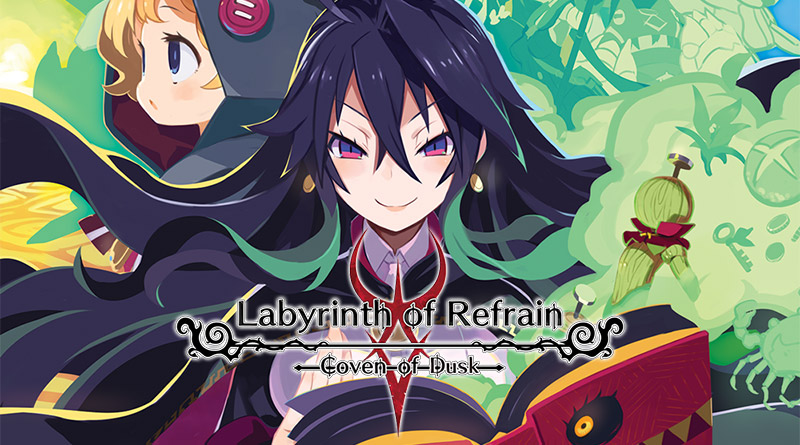
In one of my earlier posts, I mentioned how my early experiences with Dungeon Master shaped my love of the first-person dungeon crawler, and how happy I am that the genre is still alive and well in Japan.  So, even though many contemporary releases don’t reach the level of depth and immersion of that old classic, I still tend to pick them up.  Some I enjoy more than others, and despite its shortcomings, Labyrinth of Refrain was proving to be a fun example of the genre…until one of the characters was unceremoniously killed in a back alley nearly 60 hours in, and I lost.

This is a problem, because I have no idea what I did to get a bad ending.  In, say, Shin Megami Tensei: Strange Journey (another dungeon crawler), if you got an ending you didn’t want, the story made it clear that you supported the wrong people.  Going a bit further afield, in something like Nine Hours, Nine Persons, Nine Doors, if you got a bad ending, it was because you trusted the wrong people, or split the party into the wrong groups.  You might not know exactly what went wrong, but you had an idea of what to try.  Even in Silent Hill 2, a game with some of the most subtle elements that influence which ending you get, you at least see a list of statistics at the end, so you have an inkling of what you can do differently the next time around.  In Labyrinth of Refrain, I have absolutely no clue what I did wrong, and this is due in large part to how the story is presented.

See, you aren’t the main character.  Your role in things is to just venture into the (increasingly inexplicable) dungeons, kill monsters, and answer the occasional yes or no question (or remain silent).  The actual plot plays out around you in visual novel-style cutscenes, that happen mainly when you enter a new area, or find a certain item.  There’s no way to choose which scenes to watch, so I can’t opt out of the one that gets me the bad ending, and I’m at a complete loss as to what I did that got me to this point.  Did I complete a side quest I wasn’t supposed to?  Was my karma too high?  Too low?  Did I not sell enough items at the market, or too many?  None of the yes/no questions seemed to pertain to how things ended up, so I don’t think it’s that, but I have no way of knowing, because the game doesn’t communicate my mistakes at all.  And after sinking that much time into it, that’s frustrating.

The experience leading up to that point was…more enjoyable than it probably should have been, honestly.  In about 95% of the battles, I just ordered my units to attack, and sat back until the enemy was dead.  The other 5% was the early game, where you’re a lot more fragile, and thus have to experiment more to stay alive, and during boss fights.  Attack magic usually wasn’t worth sacrificing the base attack damage from your units, and it’s fairly easy to get a skill that auto-heals your party after battles, so healing magic is pointless most of the time.  What kept me going was the story I wasn’t directly involved in, and the loot…for awhile.  I’ll touch more on the story in a bit, but the loot takes some explaining, because even that has issues.

Your adventuring party consists of five slots (called covens) of units.  Each coven can hold between one and three individual units, depending on its type, with the possibility of having numerous “support” units attached as well.  And each unit has its own set of equipment: left arm, right arm, head, chest, boots, accessory.

Starting to see the issue?

Weapons aren’t so bad, because not everyone is going to be using a crossbow, or lance, but for armor, nearly every class and gender can wear any armor in the game.  So, whenever you find a new armor piece, you have to go though potentially 15+ units, comparing its stats to what they’re currently wearing.  And loot drops ALL THE TIME.  Stats are randomized (within a range) for each piece, too, and if you factor in the Diablo-style item prefixes (“breezy” sword, “odorous” traveler’s cape, etc.), there’s no shorthand way of knowing whether an item’s worth checking or not.  You can have one piece of gear with four pages of stats you need to consider.  Do you sacrifice a bit of illusion resistance for a boost to your guard chance?  Is losing some defense worth the increase in charm?  It’s micro-managing to the extreme.  But for awhile at least, it’s fun chasing higher numbers.

The dungeons themselves are distinct and nicely drawn (as are the enemies), though they’re nonsensical in how they fit together.  Maybe it gets explained in the “good ending,” how you go from underground areas, to open-air kingdoms, to towers who knows where, but it wasn’t during my 58 hours of play time.  And while there are some puzzles, they’re never terribly complex–find the key, or the switch, or the MacGuffin to move forward.

As for the story itself, it’s very disjointed, but there’s enough of a sense of mystery and foreboding, that I wish I’d been able to see it through to the real ending.  The characters aren’t always sympathetic, and some are downright confounding (like the nun who has an immediate and seemingly-inexplicable crush on one of the other characters), but underneath it all, there’s more I wanted to learn.  Something is undeniably wrong with the town of refrain, and the people in it, and discovering just what’s going on is a big part of what kept me going…which makes my sudden, unavoidable failure all the more galling.

Labyrinth of Refrain: Coven of Dusk is a hard game to recommend–or to completely write off.  There’s enough tension to the combat (will an attack miss, deal a critical hit, apply a status effect to give your units a breather?), that even just spamming “attack” like I did kept my interest in the battles, more often than not.  The maps are huge, with tons of loot to find (for better or worse).  And the graphics are quite good for a game of this type.  But at the same time, you as a player aren’t a direct actor in the story that unfolds, and whatever impact you do have behind the scenes can lead you down an unwinnable path, and good luck figuring out what you did wrong.  Also, your predilection for micromanagement might greatly influence your enjoyment, when you get to the point of having to juggle equipment between upwards of a dozen characters.  There are also some, uh…questionable scenes of either a surprisingly violent, or weirdly sexual nature, depending on which ones you get.  You never directly see anything overtly gory, or X-rated (at least I didn’t), but reading about someone being mercilessly beaten, or pursued by someone they have no interest in can be uncomfortable.  It’s a very mixed bag, but there’s some fun to be had here–just be warned that you can lose a lot of time, if the game decides you deserve a bad ending, for whatever arbitrary and unexplained reason.  Best of luck, if you decide to pick this one up.  In a very literal sense, you’ll need it.

United States of SMASH

With the release of Super Smash Bros. Ultimate just a few days away, I felt I should do something in honor of the series…in a roundabout way.  The first Smash Bros. game I played was Melee, on the Gamecube, yet I learned that word many years prior.

melee, noun – A close-quarters fight among several people.

Learned from:  Dungeon Master (Apple IIGS, Amiga, Atari ST, PC, SNES, Turbografx-CD, Sharp X68000, PC-9801, FM Towns)

Developed by FTL Games

Published by FTL Games (1987)

I remember being six or seven years old, and unwrapping this game on Christmas morning, only to see the sticker on the box that said it required an entire megabyte of memory to run.  I also remember the feeling of surprise and awe, when my father told me he’d upgraded our Apple IIGS from 512k to a whopping TWO megabytes of RAM for the occasion–to this day, I do kinda wonder if he bought the game as much for himself, as for me.

And I can understand why.  Dungeon Master is still close to the epitome of the first-person dungeon crawler, for me.  Its levels were huge and mysterious, its puzzles actually made you think, and you were just as likely to die of starvation or dehydration, as you were by falling down a pit or getting killed by monsters, if you weren’t careful.  Magic worked by entering the arcane alphabet of each spell, no area was entirely safe, and weapons and armor didn’t have obvious numerical stats, so you had to experiment to see which ones worked best for your party.

This carried over to attacks as well, where one sword might offer a slash and a slice attack, while another might be designed for thrusts.  Each type of attack used a different amount of stamina, and seemed to work better against certain types of monsters, though the more stamina used, the stronger the hit, generally.  Which brings us to the battle ax, which had a strong (yet inaccurate) attack simply labeled “melee.”  As a child of less than ten, I probably relied on that attack (and others like it) way too much, which explains why I didn’t do very well in the game until years later.

And I know a dungeon crawler is about as far from a Smash Bros. game you can get, without delving into sports, but I learned a lot of words from Dungeon Master, so this seemed like a good opportunity to get one out of the way.

dungeon_master_logo