The new normal

Don’t worry, this isn’t going to be a post all about COVID. At least, not directly. Over the past few months, the company I work for has bled off no fewer than seven employees. We aren’t large, so this has really hurt. And because there’s a labor shortage in the US right now (the exact reasons why are a subject for another time), every place is hiring. That means we’ve had a ridiculously hard time getting people to apply–and if they do apply, most of them only stick around for a month or so before leaving to look for something less stressful. “Normal” this year has become an endless cycle of working extra hours because we’re so short-staffed, leading to a more stressful environment among those of us who have stuck around, and the new employees we do get pick up on that, and don’t want to stay, leading to more long hours, and more stress, and…

I miss the old normal. Which brings us to today’s word.

mundane, adj. – normal, ordinary, commonplace

Learned from: The Immortal (Apple IIGS, Amiga, Atari ST, Genesis, NES, PC, Nintendo Switch)

Developed by Will Harvey

Published by Electronic Arts (1990)

The Immortal was an odd, but memorable game. Part-adventure game, part-light RPG, it put you in the shoes of a rather old wizard, trying to find his mentor somewhere in a sprawling labyrinth. It sounds pretty straightforward (aside from the protagonist older than 30–how often do you see something like that, these days?), but the game was anything but. Your adventure was chock-full of clever puzzles to solve (or bash your head against), traps to avoid (or blunder into), monsters to fight (or sneak by, or even befriend), and spells to cast–even spells as “mundane” as fireballs, according to the manual.

The world usually felt threatening, sometimes alien (the will-o’-the-wisps stand out in my memory), and always lived-in. Even despite the clunky controls, and some would say unfair difficulty (how was I supposed to know that chest was full of spiders, ahead of time?!), I still have very fond recollections of my time with The Immortal. Despite the bland initial setup, the game is anything but mundane.

Believe it or not, EA publishing good, inventive games also used to be normal.

Achievement unlocked

This past week has been an absolute nightmare.  Not so much for me, specifically, but if you’re from the U.S., you know what I’m talking about.  Hell, even if you’re not living here, you probably know, because chances are, your news outlets actually cover international stories.  So much is just…wrong, lately, that I wanted to focus on a word from simpler times, before the riots, and hatred, and boastful “leaders” who can’t even show their faces in times of crisis.  So, let’s visit a game full of bright colors, cheeky humor, and young girls who announce their plans to conquer the universe by way of an idol concert.  All of which brings us to today’s word:

vainglory, noun –  disproportionately high pride in one’s accomplishments

Learned from:  Mugen Souls (Playstation 3)

Developed by Compile Heart

Published by NIS America (2012)

I initially picked up Mugen Souls more for the fact that I know one of the English voice actors, than anything else.  It got fairly mediocre reviews from critics, and I wanted to support her work.  And hey, maybe it would end up being an underappreciated gem.  Well…the game isn’t bad, but it’s nothing really outstanding, either.

Mugen Souls puts you in the shoes of Chou-Chou a girl who wants to rule the universe through the power of moe.  (Moe is a Japanese term that basically refers to things that people find cute, often when they’re not supposed to be.)  Essentially, she wants to subjugate everyone by making them become infatuated with her.  But not everybody likes bubbly, pink-haired girls, right?  Not a problem!  Chou-Chou has multiple personalities, each with its own quirk: masochistic, sadistic, ditzy, bipolar, etc.  Each has its own attributes, and skills, and effectiveness against different enemies.  It’s goofy, and saccharine, and really, really weird (you can make entire continents fall in love with you.  Not the people–the landmasses themselves).

One of the passive skills Chou-Chou has is called vainglory (fittingly, in her “Ego” form).  It offers various buffs to her attacks, as well as boosts a…certain type of experience/reward you get from battles.  It’s kinda hard to explain, because while the game has a silly premise, the actual gameplay is surprisingly complex.  There are literally hours‘ worth of tutorials, explaining all the various mechanics.  And really, it was this Gordian knot of things to keep straight, along with the death of my original PS3, that kept me from finishing this game.

However, if you have a better stomach for exhaustive tutorials than I do, you might want to dig up a copy of this strange little game.  It’s certainly a different sort of experience, and maybe it’ll be just the distraction you need in these trying times.

Chou-Chou

The many faces of Chou-Chou.

Does anybody really know what time it is?

While my Pile of Shame (TM) still has a ton of games in it, I figured the quarantine was a good opportunity to tackle some of the longer ones–JRPGs, and such.  Recently, I finished the first Trails in the Sky, and I see why the Legend of Heroes series (which includes the Sky trilogy, the Cold Steel quadrilogy, and two un-localized games in between them) is so highly regarded by fans.  The plot is a slow burn until the final chapter, but once it kicks into high gear, it leads to one hell of a cliffhanger.  Anyway, today’s word…

tourbillon, noun –  a watch mechanism designed to mitigate gravity’s effect on the movement of the gears

Learned from:  Legend of Heroes: Trails in the Sky (PSP, PC, Playstation 3, Playstation Vita)

Developed by Nihon Falcom

Published by XSeed Games (2011)

Literally meaning “whirlwind,” the use of “tourbillon” in Trails in the Sky was in a more mechanical sense.  Much of the society in the game is based around technology derived from ancient artifacts (naturally).  Called “orbments,” these devices combine clockwork mechanisms and elemental crystals to produce everything from street lights, to airships, to weapons.  And as with all steampunk-ish technology, things can always be fine-tuned, hence the inclusion of tourbillons in some tech to make it more stable/accurate.

There’s actually quite a bit more depth behind the history of the orbments, as well as pretty much every aspect of the world in this series.  Hell, even most of the individual townsfolk you run across have individual names, agendas, and dialog that’s more than “Welcome to <NAME OF TOWN>!”  The sheer amount of text here can weigh things down a bit, but if you’re the sort of person who’d, say, read all the books in Skyrim, you’ll probably love getting immersed in the history of Liberl.  Even if you don’t look through all the extra stuff, the tension and interplay between various factions of the military, the Bracer guild (sort of an international police/mercenary force), and the ruling family is plenty intriguing on its own.

tl;dr:  If Trails in the Sky is any indication, this series is an underappreciated gem in the West.  And all the games that have been translated into English are now available on Steam, so you don’t even have to be a weirdo who owns a PSP, like me, to enjoy them!

trails_in_the_sky

It’s also got quite the colorful cast of characters.

My coworkers can’t spell

In the back storage room where I work, there’s a bunch of stuff that probably hasn’t been touched in years: paper files dating back almost a decade, microfilm copies of records that are older still, outdated equipment, etc.  There is also, inexplicably, a plastic container of 3.5″ floppy disks, labeled, and I quote:  “MICS DISCS”.  Putting aside the fact that “discs” should be spelled with a K in this instance, they abbreviated “miscellaneous” wrong.  Which brings to mind today’s word.

miscellaneous, adj. –  not falling into any set category, having numerous and varied traits

Learned from:  Dragon Wars  (Apple II, Amiga, Commodore 64, Tandy, PC)

Developed by Interplay Productions, Kemco (NES version)

Published by Activision (1989)

Dragon Wars was a first-person dungeon crawler, that had more of an RPG aspect than some other games in the genre (there were actually NPCs to talk to, and choices you made actually mattered, so it wasn’t all about the combat/puzzles).  It was a difficult, at times weird game that had an unexpected amount of depth.  And to some degree, that depth extended to the magic system.

There weren’t really character classes in Dragon Wars, per se, and it was really a character’s stats and training that determined what they were good at.  So, you might have someone who’s really skilled in Sun Magic, but had no High Magic spells.  If I remember correctly, there were five schools of magic:  Low (entry-level stuff), High (better versions of Low spells, and more versatility), Sun (for those who really wanted to cast the spells that make the people fall down), Druid (less damage, more summoning), and finally, Miscellaneous.  I don’t think there were many spells in Miscellaneous Magic, and thematically they didn’t seem to fit anywhere else–sort of a haste spell, and a high damage spell that wasn’t elemental or sun-based, I think.  There may have been more, but I honestly don’t recall.  But if it really was only that handful, it seems like they could’ve found some way to tweak them so they’d fit in a different school, and get rid of the pointless appendix that was Miscellaneous Magic.

Just like we should really just get rid of “MICS DISCS” at work.  I’m sure Mic won’t miss them.

dragon_wars

Unrelated note, but I really do miss hand-painted box art.  They don’t make ’em like this anymore.

Trouble’s a-brewing

A fun thing some friends and I do when we’re hanging out, and we’re not sure where to eat, is to pick a competitive game with a lot of characters, assign a restaurant to each one, and play (or watch) a round, and let the winner determine where we go.  The first game we did this with was Overwatch, but lately we’ve been setting up 32-man AI tournaments in Super Smash Bros. Ultimate.  It’s actually a really clever idea, and a lot of fun…until Diddy Kong wins, and we end up at Taco Bell.  It took a little longer than usual, but Taco Bell is doing what Taco Bell always does to me.  Which brings us to today’s word.

fulminating, adj. –  volatile or explosive

Learned from:  Diablo II  (PC, Mac)

Developed by Blizzard North

Published by Blizzard Entertainment (2000)

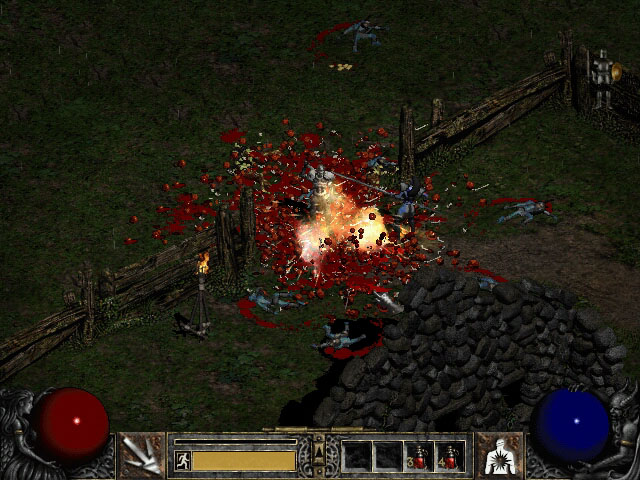
Diablo II improved upon a lot from the original game.  Though I missed some of the more random elements from its predecessor (shrines with mysterious names, whose effects were unknown until you activated them, quests that wouldn’t show up in every playthrough, etc.), the sheer variety of new material made up for it.  One of these additions came in the form of offensive potions: green for poison, and orange for explodey-types (including fulminating potions).

These were kinda neat in the early game, as they gave even melee-focused characters a source of elemental damage, but there were only a couple “levels” of each type of potion, and they didn’t scale with your character’s level.  So, as the enemies you faced kept getting stronger, the damage inflicted by these potions became less and less useful, until it became a pain to find them in item drops.  A cool idea, but ultimately one that wasn’t used to its fullest potential, so that it might’ve been more than a novelty.

fulminating

Don’t let the screenshot fool you; fulminating potions would be hard-pressed to cause that kind of carnage in the early game.  In the later stages, you’d be lucky to give the monsters a sunburn.

In sticking with a theme…

It would appear I still have an ax to grind, after that last post, but this time around, I’ll strive to make the entry more about the game, than the real world.

mendacious, adj. –  relating to deception, falsehood, or divergence from the truth

Learned from:  The Elder Scrolls V: Skyrim (on damn near every platform since the XBox 360 and Playstation 3)

Developed by Bethesda Game Studios

Published by Bethesda Softworks (2011)

There are a lot of books scattered throughout the realm of Skyrim, and most of the words this game taught me came from a series of tales about the dark elf, Barenziah.  There are plenty of other stories to be found, but for whatever reason, the writers decided to be the most verbose in talking about this particular elf.  Mentions of mendacious caravans seeking to avoid paying tolls, or chary subjects, distrustful of their new rulers abound in the history of this character whom (to the best of my knowledge), you never actually meet in the game.

When you think about it, it’s odd that Skyrim gets as much praise as it does for being so “deep,” when so much of its lore breaks a cardinal rule of storytelling.  e.g. telling, instead of showing.  We’re (largely) well past the era of the text adventure, and video games are an inherently visual medium; we could very feasibly be seeing these events instead of killing our eyes, squinting at chapters of raw text in a virtual book, on a TV screen across the room (or a monitor on our desk).  It’s like an audiobook presented in Morse Code: it really doesn’t take advantage of what the format has to offer.

skyrim

Skyrim: 10th Anniversary Edition, coming soon to a graphing calculator near you!

Totally not a political statement

It’s Independence Day, and as such, I found myself presented with a variety of words I could feature, from words about empire-building, or rulers, or even just related to how bloody hot it is.  In the end, I chose…

braggadocio noun –  The annoying and/or overblown talk of someone trying to come across as braver than they truly are.

Learned from:  Shin Megami Tensei IV  (3DS)

Developed by Atlus

Published by Atlus (2013)

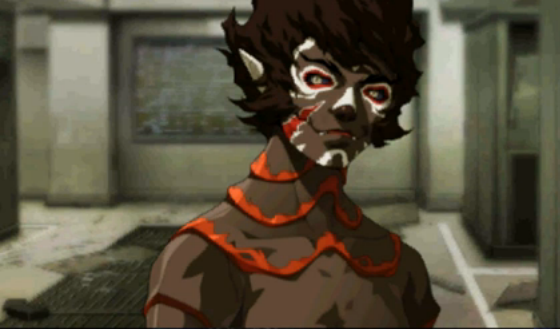
Toward the end of the game (at least, along the path I took), you run into a demon named Akira, who wants you to help him take over Tokyo.  However, the old adage “the smaller the dog, the louder its bark” definitely applies here, as you quickly discover this guy is a terrible coward.  The rest of your party even comments on his braggadocio, the first time this guy hides behind you, and expects you to fight his battles for him.  Because those are exactly the qualities we all want in a leader, right?

Or, you know, ordering a military parade with tanks rolling down city streets, when the greatest risk you’ve ever put yourself in is swinging a nine iron.  Things like that.

akira

At least Akira’s got good hair.

I’ve been living life, like I play Risk

You may have noticed that I dropped off the face of the Earth, recently, after the spate of live tweets I did for E3 (and I never did get to the Nintendo Direct, or PC Gaming Show).  In the time since, I’ve found myself pulled in all sorts of directions at once, both at work and at home.  They’re not all bad by any means, and a sizable portion of them, I brought upon myself, but between contemplating going for a promotion at work, learning an unfamiliar tabletop RPG so I could join a game a friend was setting up, trying to get people together for my own game I want to run, diving headfirst into my backlog of books and games, and finding a surprising number of evening events, I’ve spread myself thin.  Which, in a roundabout way, brings me to today’s word.

druthers, noun –  One’s leanings or preferences toward a subject.

Learned from:  Shin Megami Tensei Devil Summoner 2: Raidou Kuzunoha vs. King Abaddon (Playstation 2)

Developed by Atlus

Published by Atlus (2008)

First off, yes, that’s the full title of the game.  Whereas most of the Shin Megami Tensei (MegaTen for short) titles have turn-based combat, the Devil Summoner series set itself apart by being more action-oriented.  It takes some getting used to, trying to manage the demons you’ve summoned on the battlefield, while keeping your own character alive, but it really grew on me, the more I played this series.  And the action isn’t all that set it apart from its contemporaries.

I don’t think I’ve ever seen another RPG set in 1920s Japan, let alone one whose story features underground insect people, a talking cat who used to be your human partner, demons, and a spunky female reporter who gets caught up in the middle of it all.  Throw in an amazing soundtrack, and a plot that tackles surprisingly deep subjects such as tradition vs. modernity, sacrifice, and self-preservation and you’ll start to understand why Atlus is one of my favorite game developers of all time.

As for the word of the day, at one point the protagonist gets asked what his druthers are, regarding one of the plot points.  Choices matter in this game, and depending on how you approach things, you’ll get different endings–another hallmark of the MegaTen franchise as a whole.  And to tie this all in to the intro, I need to consider what my druthers are, and narrow my focus regarding all the stuff I have going on.  Because I know from (extensive) experience what happens when I keep myself spread too thin for too long, in Risk.  But hey, realization is the first step and all that, right?  See you next time!

devil_summoner_2

A not-so-reasonable facsimile

In my job, I work with money, and every so often I come across a situation that isn’t entirely…on the level.  It’s been happening significantly more, lately, and with the increased frequency has come a dip in the quality of the attempted fraud.  Really, some of these fake checks are almost laughable.  But the situation did prompt me to pick today’s word.

ersatz, adj. –  fake, not genuine; an imitation (of generally lesser quality).

Learned from:  Shin Megami Tensei IV  (3DS)

Developed by Atlus

Published by Atlus USA (2013)

Shin Megami Tensei IV is an odd game, with a world that is by turns high fantasy, and near-future cyberpunk.  The sci-fi portion has most of the trappings you’d expect from a modern dystopia:  oppression, cynicism, crime, and black markets, galore.  Even the bars can only offer up ersatz refreshments, because all the real stuff is so hard to come by.

I’m being deliberately vague on the details of the setting beyond this, because I feel like I may have already given spoilers.  And really, this is a game that deserves to be played with as fresh eyes as possible.  As with all games in the MegaTen series, it deals with some pretty heavy themes, and does so in such an unflinching manner, that it’s rare to see other games even try to imitate this particular approach.

smtiv

Not to be confused with Shin Megami Tensei IV: Apocalypse, which is (I gather) an entirely different game…that I really do need to play at some point.

Happy Pi Day!

Obligatory pie-related post for 3.14, and it’s a bit of a long one.

atelier, noun – A workshop–specifically the workshop of an artisan, artist, or designer.

Learned from:  Atelier Rorona: The Alchemist of Arland (PS3, PS Vita, Switch)

Developed by Gust

Published by NIS America (2010)

Atelier Rorona isn’t a game about saving the world, or overthrowing an evil empire, or anything like that.  Instead, it’s about trying to keep your master’s alchemy shop from going bankrupt.  But the small scale of the adventure doesn’t mean it’s any less harrowing.

You’re given a series of tasks to complete for the king, to prove to him that your shop is worth keeping around, and each of these has a time limit.  And everything takes time.  Going out to collect ingredients eats up time.  Making items takes time.  Side events?  You guessed it: time.  It’s a surprisingly tense mechanic for a relatively prosaic concept.

Thankfully, you’re not alone in your quest, as a variety of colorful characters will join you, from a puppeteer, to a ghost, to a journeyman cook…and that bloody cook is what ties this in to Pi Day.  Iksel wants to become a famous chef, and his goal is reflected in how he acts in the party–a lot of his moves can heal or provide buffs/recovery for the rest of the characters.  Plus, he dishes out (pun fully intended) a good amount of damage, to boot.  He was one of my strongest party members…and then I made too many pies.

See, in Atelier Rorona, you have two kinds of leveling: character levels, and your alchemy skill level.  You need this latter to be high enough to make certain items, so you’ll occasionally have to grind lesser items to get there.  A good way through the game, I had a lot of ingredients for making pies on-hand, and decided to use some of my time churning those out like nobody’s business (alchemy can make damn near anything in Japanese RPGs).  So, I’m going about my business, when one day, Iksel bursts into my shop, sees what I’m doing, and thinks I’m trying to upstage him.  He then challenges me to a pie-making contest a week later, storms out of my shop, and leaves my party.  I still hadn’t gathered the ingredients I needed for whatever the king was asking for, and without him in my lineup, I was left with some severely under-leveled alternatives, to fill the gap.

Looking back on it, years later, I’m actually rather impressed that Gust put in such an obscure Easter egg.  It adds a layer to the character, and makes me wonder what other events I could’ve unlocked by accident.  But at the time, I’d lost one of my best characters, and I was pissed.  Some time later, my PS3 bit the dust, and I lost my save files, so I still haven’t beaten this game.  I really should revisit it at some point, because the series is huge, and I did enjoy my time with Rorona up until this point.

iksel

Look at this smug bastard.